Range Repair
Wolf burner clicks but will not stay lit: what Phoenix dust does to it
A sealed burner that only holds a flame while you press the knob in is almost never a gas supply problem. Here is what the safety circuit is doing, what the monsoon leaves behind in it, and what is worth checking before anyone comes out.
Written by
Thandiwe Mokoena
Cooking-appliance technician — convection and airflow · 16 years in the trade
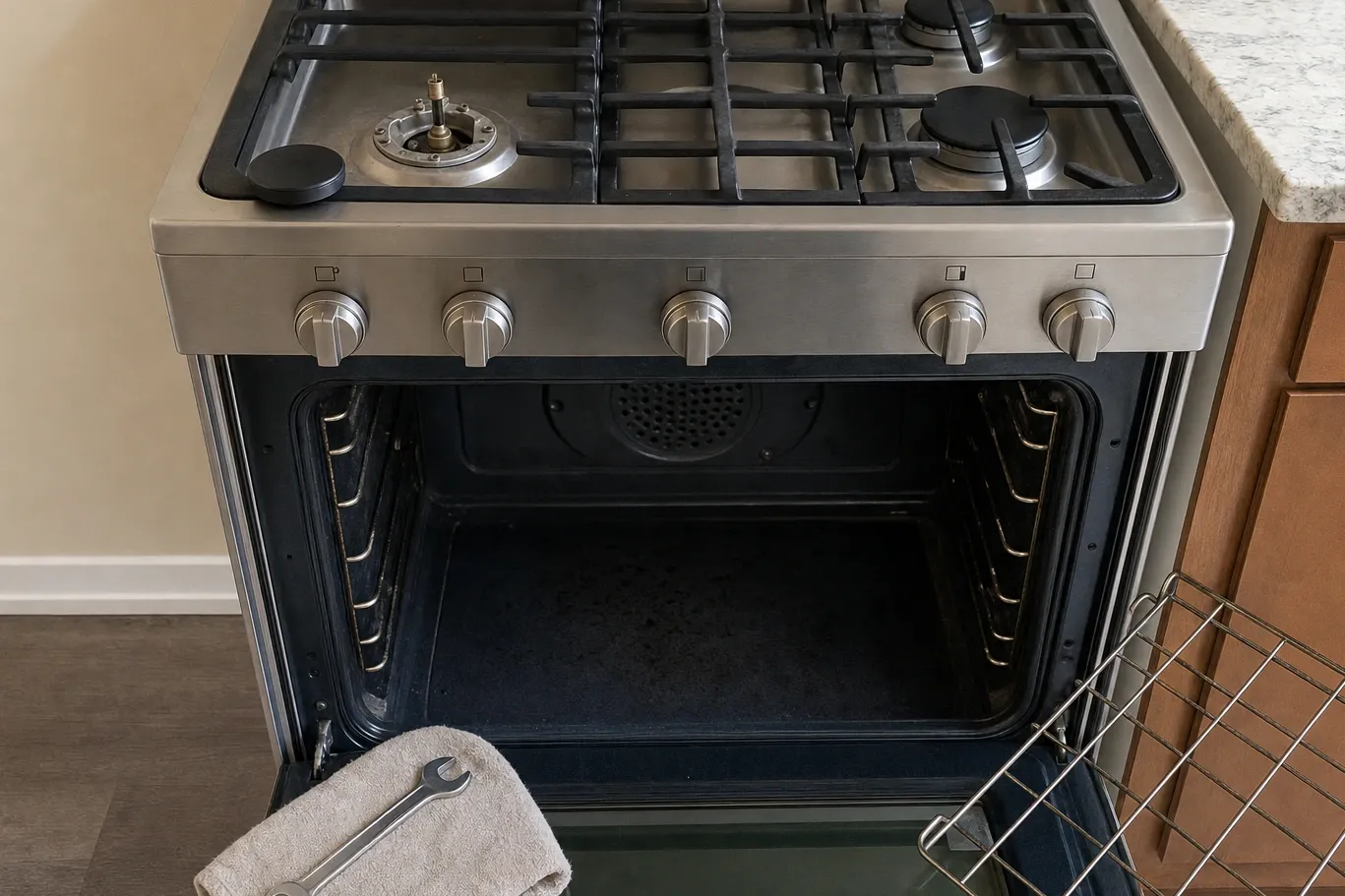
You turn the knob, the igniter ticks away, the flame catches, and the moment you let go of the knob it dies. Hold the knob in for fifteen or twenty seconds and it stays. Let go and it goes out again.
That symptom is worth recognising, because it is one of the few on a gas range that tells you almost exactly where the fault is. The burner is not short of gas and the igniter is not dead — both of those would look different. What is happening is that the appliance is lighting the burner and then failing to convince itself that it did.
What the appliance is actually doing while you hold the knob
Every sealed burner on a modern Wolf range sits behind a safety interlock. The gas valve will only stay open while the appliance has proof of a flame. On a spark-ignition range that proof comes from the electrode itself: once the burner lights, the flame conducts a tiny current across the gap to the burner body, and the control reads that current as “yes, there is fire here.” On models with a thermocouple instead, the proof is heat rather than current, and the principle is identical.
Holding the knob in mechanically bypasses that interlock. You are physically holding the valve open while the sensing circuit makes up its mind. Fifteen seconds is roughly how long a marginal circuit needs to warm or to build enough signal to latch. When you let go before that, the valve springs shut and the flame drops.
So the question is never “why is there no gas.” It is “why can this burner see its own flame less well than it used to.”
The four things that cause it here, in the order we find them
-
Grit packed into the igniter shroud. This is the Phoenix answer, and it is the majority of these calls. The electrode sits in a small ceramic-lined pocket beside the burner base. Monsoon dust is fine enough to get through a kitchen and heavy enough to settle, and it builds into that pocket until the spark is bridging half its gap through compacted debris. The burner still lights, because a weak spark is enough to light gas. The flame-sense current is the part that suffers.
-
Ports blocked on the sensing side of the burner. The flame has to sit against the electrode to be sensed. If the two or three ports nearest it are partly closed by boil-over or grease, the flame leans away and the signal halves.
-
A valve stem starting to bind. Ten years of thermal cycling in a hot kitchen dries the grease in the stem. The valve no longer springs fully open when you release the knob, so the flame drops below sensing size. This one usually comes with a knob that has gone stiff or gritty to turn — worth noticing, because it is the tell that separates it from the others.
-
A tired spark module or a bad ground. Least common, and the one that affects several burners at once rather than one. A module that has lost output still sparks visibly but cannot pass a sense current cleanly.
What is worth checking before anybody comes out
Take the grate off, lift the burner cap, and lift the ring under it. Both come away by hand on almost every Wolf top; nothing needs a tool.
Look at the electrode. It should be a clean ceramic post with a bright metal tip sitting in an open pocket. If the pocket is full of pale grey dust, brush it out dry with a stiff brush — not a wet cloth, and not a spray cleaner, both of which turn dust into a paste that bakes on.
Then look at the ports around the burner ring, particularly the three or four closest to the electrode. They should be open slits of even width. A sewing pin clears them; a toothpick breaks off inside them and makes the problem permanent.
Refit everything dry and try again. If the burner now holds on release, that was it, and the useful thing to take away is the interval: in this valley that cleaning wants doing before every summer rather than every few years.
When it stops being a cleaning job
If the burner still needs the knob held after a proper clean, stop there. The remaining candidates are the sensing circuit, the valve and the module, and all three want a meter rather than a guess.
Two symptoms move it out of the cleaning category straight away. The first is a stiff or gritty knob, which points at the valve stem. The second is more than one burner behaving the same way in the same week, which points at the module or the ground rather than at housekeeping.
And one symptom moves it out of the diagnosis category entirely: any smell of gas that lingers after the burner is off. Shut the appliance down at the wall, open a window, and do not relight it.
What a visit for this looks like
A flame-sense fault is measured, not inferred. The electrode gap gets checked against spec, the sense current gets read while the burner runs, the valve gets tested for full travel on release, and the ground path gets confirmed. That sequence usually finds it in under half an hour, and it distinguishes a burner that needs cleaning from a valve that needs replacing — which matters, because they are very different repairs.
Whatever it turns out to be, every joint that came apart gets leak-tested and every burner on the top gets run before anyone leaves. A range that has one burner in this state very often has a second one heading the same way, and it is better to know that on the day than in August.
Follow-ups
Is it safe to keep using the burner if I hold the knob in?
It works, but you are holding a safety device open by hand, which is exactly what it was fitted to stop. Use another burner and get it looked at. If you can smell gas at any point, shut the appliance down at the wall and do not relight it.
Will cleaning the burner myself fix it?
Sometimes, and it is worth ten minutes. Lift the cap and the ring, brush the ports out dry, and clear the slot the electrode sits in. What you cannot do from the top is test the flame-sense circuit or reset a valve stem that has started to bind.
Why does it happen to two burners at once and not all six?
Because the burners that get used hardest cycle their electrodes the most, and because the two nearest the oven vent take the most heat and the most airborne grit. Faults cluster on the burners you cook on, not evenly across the top.